- Gardening adventures, Permaculture and Edible Forest Gardening Adventures, Photos, Vegetables, Vegetarian
Eating from the Garden

Mesculn Mix Beginning last week, I’ve been able to serve at least one thing from the vegetable garden every night at dinner. Peas, Swiss chard, lettuce, cilantro,radish, more peas, chives, carrots, strawberries, and, of course, peas. I munch as I water and weed, and feel that for a moment, here at least, all is right with the world. Like so many gardeners everywhere, I await the taste of my first tomato, but since my plants are no more than three inches high, I have awhile to wait.

Purslane Every year I have a bumper crop of purslane growing as a weed in my beds, and this year is no different. However, I’ve read where purslane has more Omega-3 fatty acids than many fish, something we vegetarians should be aware of. Originally from India, and supposedly Ghandi’s favorite food, this succulent member of the Portulaca family offers other nutritional benefits as well. See http://www.nutrition-and-you.com/purslane.html . If uprooted and left on the soil, the plant uses its stored liquids to produce seed and scatter them. “So there!” it says. I must admit that the thick leaves and stems are off-putting for me texture-wise, but I’ve begun to snap off young stems and include them with the lettuce I’m harvesting. I’ll have to be bold and find better uses for it in my kitchen. After all, its free!

Purslane I created two new raised beds, lined with aviary wire (which is a devil to work with. I have scratches all over.)

New raised beds I still have two more raised bed kits, which I bought last Fall in a clearance sale. I’ve leveled them, placed cardboard on the ground to deter weeds (especially the dreaded Bermuda grass!), used a staple gun to attach aviary wire across the bottom and up the insides a little, then filled with topsoil and very wormy mushroom compost, then watered it all in. I still have to add more good soil, then I’ll mix in some Garden’s Alive non-animal organic vegetable fertilizer and some microbes, just to start the beds off right.

Seed Sprouting These beds will be for the vining plants such as squash, pumpkin and melons. There is room for vines outside the beds. Already I have the seeds sprouted and awaiting transplanting, but that won’t happen until early next week.
Roger and his crew hauled over prunings from grape growers, and have used them to sparkle up the trellises to wonderful effect.

Grape vines on trellises I think they add a wonderful ethereal look to the structures.
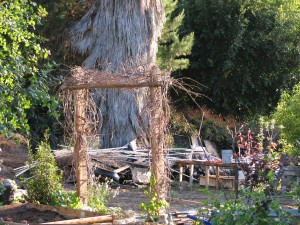
Viney trellis As far as the ponds go, contouring is slowly being done and we all await the coming of the pump on Monday. I will not be blogging for the next few days because I will be attending the Southern California Permaculture Convergence in Malibu http://www.socalconvergence.org/ , and as I will be sleeping in a bunkhouse at Camp Hess, I’m thinking that bringing my laptop would be a bad idea. I’ll take photos and be excited to share what I’ve learned with you when I return. Have a wonderful weekend!
-
Chickens in the Tractor

Grass? Easter Sunday brought new horizons to the chickens. Finally they were allowed out into the tractor. The largest bird, one of the Americaunas, was almost touching her head to the screen over the top of the Sterilite container in which they lived. The girls were a little startled at the sunlight, and didn’t quite understand about grass at first. Then they got into scratching with their already huge feet and pecking off weed tips.

First Scratches Unfortunately, the Barred Rocks girls are still smaller than the others and were being pecked and chased by the larger girls. They chose their corner and the big girls grouped on the other side of the tractor. They all wandered and changed positions with some pecking going on. The BRs were just too frightened, so I set the bird cage in which they had been living into the chicken tractor and put them into it. They have their own food and water, perches, and are able to be with the big girls without being set upon. Funny thing, though, the BRs would hop up onto the two cross-boards when escaping the big girls, but I’ve never seen one of the big ones up on the boards. I think this is because the BRs lived in the bird cage and learned to perch!

Barred Rock Corner I was wary about allowing the dogs out into the yard with the chickens in the tractors. In their younger days, these two killed all of our chickens who were loose in our backyard. It was a Valentine’s Day massacre. That was the day DC met her end (see post about DC the chicken). Now that the dogs are senior citizens and mostly deaf, they didn’t take as much interest as before.

General Interest in Chickens When they came too close to the cage, I used a spray bottle of water and admonishments. It seems to have done the trick. That spray bottle is what keeps the cats under control in the house, too. I just have to pick it up and all bad activity stops. I wish it worked on kids as well!
At night, the chickens still don’t know how to get up onto their loft. After dark my son and I go out there and drape a blanket around the BR’s birdcage for warmth, and find the big girls in a group on the ground. Chickens at night are like footballs, and can be picked up easily and placed into their loft. We’ve tried to get them to walk up the ramp, but it is too much of a learning curve for them. We’ve also set them up on their loft during the day, but they just flutter down. I have to believe that they’ll grow into it.
It is nice to have the chickens out of the side room, and really good for them to be scratching and pecking and enlarging their diet with grass and bugs. They certainly eat a lot of chicken food. Pretty soon it will be lay mash time!

Pretty Girls You May Also Like
Native Insects and IPM
-
Happy Spring
-
Peas

Tendrils Peas are certainly one of the most joyous vegetables of Spring. They should be planted early when the weather is still cool. Their emergence from the seed through topsoil is one of such strength and energy during what are normally pretty dreadful months weatherwise. Peas are plants of hope.

Peamergence Not only are peas a nutritious early vegetable, but the plant itself is important to your garden. It belongs to the Leguminocea family of plants, or legumes, many of which host bacteria known as rhizobia in their root nodules in a symbiotic relationship. These bacteria take airborne nitrogen gas and convert it into a form usable by the plant in a process called nitrogen fixation. In English, peas fix nitrogen in the soil. Higher nitrogen absorption makes legume seed higher in protein than non-legumes. The legume family includes some plants that you are familiar with such as beans, peas, clover, alfalfa and lupines, and some you may be amazed at such as mesquite and acacia. The importance of the Leguminocea family, which is the third largest plant family, is a perfect example of the idea of plant guilds, where every plant has a different purpose that helps the other plants in its guild. When I think of mesquite, I think of Westerns and deserts. I’m in wonder at the idea of this beautiful hardy plant fixing nitrogen in the sandy soil. Legumes can be used for crop rotation to boost poor soil, or as in the case of clover and vetch, turned under as a green manure. So growing peas in your garden benefits your soil, as long as you leave the roots in the ground when pea season is finished. In fact, you can just turn under the whole plant, and before long it will have composted.

Pretty Plants Preparing peas brings to mind stories of the women-folk sitting on their front porches in rocking chairs shelling hundreds of peas. Quaint, but perhaps not practical for many time-challenged people. Although picking and shelling peas does take time, it is quiet time, a time for reflection and planning. Peeling open a fat pea pod and scooping out the sweet, slightly starchy bright green treasures inside is as much a pleasure as biting into the first tomato of the season. There are, of course, alternatives to shelling peas.
Three Types of Peas Snow peas have a tender, crisp shell and the inner seeds don’t swell significantly enough to shell. Found mostly in Asian cooking, snow peas can be added to any dish or salad. They are much better fresh than the stringy, hard green sheaths found in many frozen vegetable mixes. Of course, there are shell peas, which you leave on the vine until the pods are nice and fat, then string the pod and scoop out the inner seeds to eat, composting the pod. A wonderful compromise is the edible-podded shell pea. It can be eaten small, like a snow pea, but if you leave it on the vine the peas inside the pod will swell and you can eat it like that or shell them. Since once peas get started emerging, there seems to be no end of them of all sizes for awhile, the edible-podded shell pea is a less harsh taskmaster . My favorite way of cooking pea pods is to stir-fry them in hot olive oil for just a couple of minutes. Or they can be steamed, or added directly to soups. They are also good to use as dip scoops along with other fresh vegetables.
Snow Peas Large edible-podded or snow peas need a little preparation. Their bud-end should be snapped off, and if there is any string down the side, it can be pulled off in the same movement.Pea tendrils are edible, too, and are sometimes found as the new fancy food in magazines. I’ve tried them and wasn’t impressed. The flavor was green and the feel of the little tendrils in my mouth wasn’t comfortable. Watching tendrils seek a support, then grab on and pull the plant over in a tight grasp, has always impressed me as such intelligent behavior that I feel funny about snipping them off and cooking and eating them!Speaking of grabbing tendrils, peas need support in your garden.
Training They usually grow about three feet high, so train them up string, wire, thin stakes, or whatever your imagination cooks up. Since harvesting peas takes a little time, plant the peas close to the edge of your bed, or where you can comfortably reach the pods without tearing out the whole plant or wrecking your back.Peas are bright green with pretty, easily accessible (to bees) flowers, and make a handsome addition to your garden. This year I
Pea Flower planted fresh organic seed, and then because I had several very old packets of peas left, planted them around too. Of course, they all came up! I planned to turn the extra under as green manure, but didn’t have the heart. The extra peas that I can’t immediately eat I’m blanching and freezing. Blanching is to take a vegetable and immerse it in boiling water for no more than a couple of minutes, then immediately dip in cold water to stop the cooking process. The vegetable should be dried then frozen in freezer-proof bags or containers. Blanching doesn’t take long, can be done with water boiled for pasta or steaming vegetables for dinner.

Small Is Best for Snow Peas You May Also Like
The Coon Saga: The Luck of the Draw

The Battle of the Bulge
Native Insects and IPM
-
Pond Progress
Happy Earth Day!
As of today, I have a very large hole in the ground with a little puddle in it!

A Vernal Pool? The major tractor work was finished by Dan Barnes (if you need mowing, disking, or any kind of tractor work, he’s the guy to call at 760-731-0985). A pump was set up in our shallow well and it started… then stopped. The water was so silty that it plugged the pump, and the refill rate isn’t very quick in the tube, either. So unfortunately the goal of having a full pond by the end of the day today was not realized.

The Pump Work will resume on Monday with a flushing of the well. Dan found a lot more bottles buried in the middle about three feet down. No Inca gold, though. Dan also moved some boulders around and disked the soil along the pathway that rainwater will take through the property.

Dragging Boulders 
Tilled watercourse Finish work with the small tractor will be done beginning next week. The good thing about the pond not being filled yet, is that my dog General, who is a cross between two waterdogs, won’t be soaking wet for Easter. He’s still enjoying being in the house while there are trucks and tractors in the yard.

Pond in the Evening with a set rock Also today more stairs were created at my request by Roger’s team of Juan and Francisco in the area leading down the hill, which was just too slippery. They squared up the hearts of some palms this time rather than just cutting off the tops. The resulting white rectangles look incredible.

Palm Stairs I’ve noticed a lot more birds and lizards in the yard, even with the workmen disturbing the peace. I really can’t wait until the project is finished and I have regained tranquility on my property. After the ponds are in there is still more planting and irrigation to be installed. Sigh. Have a wonderful Easter Sunday!
-
Partial Pond

The Grading Begins Today the work finally began on the series of ponds, swales and rain catchment basins that are the heart of the permaculture project. Their object is to catch, channel and hold rainwater so that it percolates slowly down into the ever increasing loam of the forest garden, making water available longer for the plants rather than sheeting off the top of my property and eroding the embankments.

First Scoops The blue stakes delineate where the water will fill to. The edges are irregular to create more edge space for plants and animals.

Tractor Dan with Greenie Dan Barnes Tractor Work ( at 760-731-0985) has worked with Roger Boddaert in the past, and has done some work on my project already. Dan is an artist with the tractor. Although much of his work is mowing and disking, he has created ponds and swales in the past and really knows what he is doing. If you need tractor work, Dan is your man. He owns several different sized tractors, or he rents the appropriate size and does what you need in excellent time for very reasonable rates. Plus, he’s just a great guy.

Dan, Jacob and Aart Discussing Grades Here Dan, Aart de Vos and Jacob Hatch discuss the grading plan. Aart owns Aquascape Associates pond landscaping, specializing in natural ponds. Drawing from his Northern European heritage and knowledge, Aart believes in simplicity, old technology that is proven to work, small footprint and natural environments. He and his manager Jacob Hatch knew exactly what I wanted, and the work that I’ve seen of theirs looks as if man had nothing to do with forming the ponds. Not only did they know what I wanted and were already experienced at it, but their prices are very reasonable in comparison to some quotes we received for ponds that would have looked artificial and have been electricity monsters.

Canine Clay Treatment At lunch break, my dog Sophie loved the excavation and gave herself a very good roll in the clay.

Mostly Done At the end of the first day, the rough work on the lower pond is almost done. Tomorrow Dan will finish this and move on to the rough work of the next area. Jacob and his team will begin the contouring of the big pond with the small tractor and by hand.

Shiny Clay.. for once a good thing At the depth of six feet, there was a wonderful layer of clay. The ponds are not going to be lined with plastic or polymer; instead, Aart believes that the compacted natural clay should be good enough to keep the pond filled. The water source for all the ponds, besides seasonal rainwater, is a four-inch wide drill hole that was augured near where the lower pond sits. Water was found nine feet down. A small submersible pump will be lowered to pump water into the ponds. At first the pump will be run by an extension cord. Then it will be replaced by either solar or a windmill… I’m looking into the noise that windmills make because I need and desire my quiet.

Culvert Cleaned This is where all the neighbor’s runoff funnels through to my property in the upper corner. Before it would make a 90 degree turn (or attempt to) in a narrow cement culvert and be diverted all the way down my property and off into the streambed below. Except for when it really rained hard or the culvert became silted in from the neighbor’s topsoil. Then it would flood the entire property and erode everything in it’s wake. This entrance area was cleaned today by Cody, who works with Jacob. The water will still channel through here, but it will be diverted into a dry streambed and on into the swales and ponds. Then it will be held, slowly perculating into the loam and soil to be available for the deep roots of the trees and plants.

Entrance to the Bee Garden Also worked on today by Roger’s team was this arbor to the entrance to the Bee Garden for honeysuckle and other vines to grow over. I’m sprouting luffa gourd seeds; perhaps some can grow up these and hang down over the entrance.
When me and my chilren moved here twelve years ago, we hoped to find buried treasure on the property. What we found in the areas most suseptable to erosion was piles of palm fronds, auto tires, and a buried toilet (which is still there). At the end of the day today Dan called out to me that he’d found the buried treasure.

Treasure One of the bottles was capped and was half full of liquid. I sniffed it…. only muddy water. Shucks.
More tomorrow!
- Gardening adventures, Permaculture and Edible Forest Gardening Adventures, Photos, Vegetables, Vegetarian
My Gardens Today
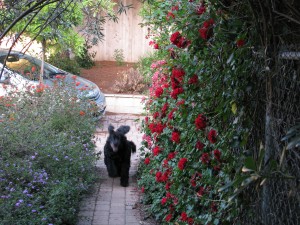
Entranceway with Running Dog April and May are months that I often don’t remember when reflecting back at the end of the year. Spring is such a busy season. When I was raising children, and when I was working as a school librarian, these months rushed past in the haste towards summer break. As a gardener, Spring is one season when I turn into one of those Garden Designers London and since it is also the season of intense growth of both weeds and desirables, insects and increasing dryness, and for me and so many others, the inevitable allergies that keep me out of the garden for days. So I thought I’d post photos of my gardens as they stand today, in the middle of April, on threshold of Summer.

By the Front Door I’ll start at my front door and work downhill. The walkway to the front door is lined with purple lantana and a mixture of red geraniums, honeysuckle, butterfly bush and Double Delight rose. It is being enjoyed by my very silly old dog General Mischief, who just realized that I was going to let him into the house. He looks a bit like a vampire dog in this photo, though!
By my front door I have a collection of miscellaneous plants, as most people do. Two staghorn ferns given me by my mother have attached themselves in a very satisfactory way to the chain link fence. There is also a dark red ivy geranium, needlepoint ivy, some bulbs just out of bloom, a traveling (or Egyptian) onion (it’s seeds are bulbets grown on the flower) that my brother gave to me, and some sedums. When I water here I usually disturb a Pacific Chorus Frog or two. I’ve thinned and weeded and replanted this collection, but there are always more that magically appear.
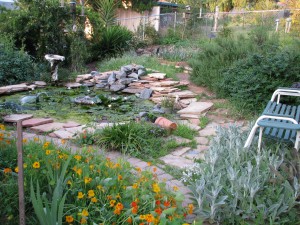
Front Pond The front yard pond is full of algae, but that is all right for the moment. I don’t want a crystal clear pond; I want habitat. Because of the clear blobs of frog spawn and wriggling tadpoles hiding from the hungry mouths of the mosquito fish I keep the algae until it is no longer inhabited. Waterlilies (even the monster one! Look at other posts for an explaination) are blooming with last weekend’s sudden heat. In the foreground are Jewel Mix nasturiums with heirloom tuberoses emerging, a grey mound of lamb’s ear which has begun to pop up where I don’t expect it, and rosemary by the bird feeders. Our kitchen table has the view of the feeders, and it is from this yard that we count birds seasonally for Cornell University’s Project Feederwatch. Oh, and try not to focus on the weeds, please.
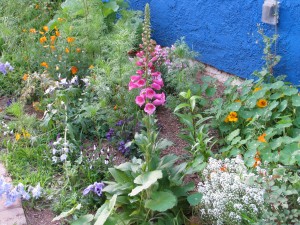
Side Gardens On the South side of my house I’ve painted the wall a Mediterranean blue to reduce the glare and create a colorful backdrop for flowers. I keep annuals in this bed, along with some bulbs and a rose that is still small that my daughter gave to me. In th photo just blooming are naturtium, alyssum, foxglove, pansies, and a delphinium that fell over and started growing upright again. My library window overlooks this yard. I was trying to keep the color scheme focusing on apricot to show up well agains the wall, but I end up planting whatever I want in here. Cosmos have again reseeded and are starting to grow rapidly; they’ll block the window by summer and be full of goldfinches. I’ve also planted a couple of bleeding hearts that I picked up in one of those bulb packages at WalMart. Usually the plant is pretty spent and they aren’t worth the money, but I somehow think that I am rescuing the poor thing. These came up but haven’t yet bloomed.
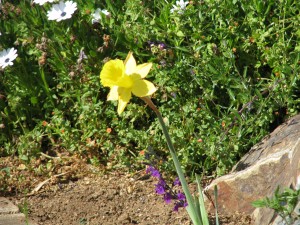
Lady Banksia Along my driveway is a Lady Banksia rose that has taken off, along with a bush mallow, a Hidcote lavender, and a late daffodil. Farther along the driveway (not shown) is a Pride of Madera (I love that name!) that is going gangbusters, a small liquidamber, rockrose, a mixture of natives and incidental plants such as a tomato that survived the winter, a Joseph’s Coat rose, and an established pine tree with a crow’s nest at the top. There are other roses and plants here, too, like a prostrate pyracantha for berries, a white carpet rose, native milkweed for the Monarch butterflies (perennial ones; the annuals are usually gone by the time the butterflies migrate here), an apricot penstamon, aloe vera, and probably the kitchen sink, too, if I root around long enough. I love tinkering around with this mess of plants, seeing what will grow and trying new combinations.
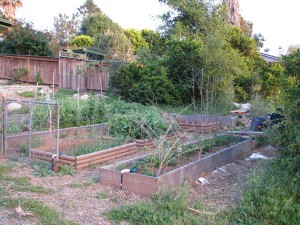
Raised Vegetable Beds In my raised vegetable beds the peas have been producing well. The shorter ones had been nibbled by crows as they were emerging, but after I put a rubber snake amongst them, the nibbling stopped. Potatoes are nearing harvest time, and I’ve already snuck out a few new potatoes and they were very good. Sometimes I’ve had potatoes with brown fiber in them and a bitter taste; no doubt due to irregular watering and soil problems. I worked hard on improving my soil and giving it a boost with natural fertilizers from Gardens Alive. There are so many peas in the garden because I planted all my old packets so that the roots will set nitrogen in the soil.
I also have growing carrots, broccoli, cilantro, parsley, endive, salad mix, parsnip, strawberries, blueberries, breadseed poppies, horseradish, asparagus, bush beans, fava beans, a yellow tomato and a red slicing tomato, garlic, shallots, red and white onions, Swiss chard, leeks, collards and basil. Most are just small guys right now.

Seedlings In my temporary nursery area I have sprouting pickling cucumbers, zucchini, quinoa (first time!), more basil, Dukat dill, cantalope, and a cooking pumpkin. I’ll sprout more squashes and maybe popcorn and sweet corn soon.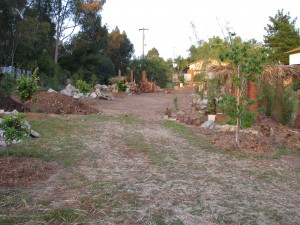
View up the Middle This is a view of the middle of my property, from the lower end up.
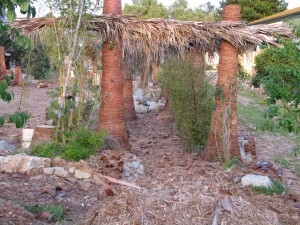
Palm Tree Walkway This is the palm tree walkway as it stands now.

Pre-Pond And this is the lower area. Notice the stakes in the ground and the tractors? They are there because today is the day the ponds will be excavated! The rain-catchment ponds, permanent habitat pond and swales will be carved, shaped and filled in the next two days, fed by water from a 4-inch well augered in the lower property. I have hired Aquascape to create habitat and rain catchment ponds; the demostrations of their work look as if humans hadn’t messed with anything. In about an hour from now, the action finally begins! After the ponds are installed, then the final plant guilds will be established, the minor amount of irrigation installed, and that will be that! I’ll keep you posted on pond development! -
When Chickens Fly
My seven chickens are quite the young women now. They really should be out in a pen, not still in a Rubbermaid container in the side room, but tractor work will be started this week and I don’t want to horrify them with large machinery. The big girls have begun to squat on the floor like broody hens. Most of their feathers are in and they look very sleek and lovely. The Americaunas, who are almost two week older than the others, are much larger and also much shyer. They are usually at the bottom of the pile when I go in to change their water. Why is it that I’ve held them, fed, watered and cleaned them, crooned to them, and every time I put my hand in there they start screaming and flying around as if I’m going to murder them? I’ve explained my vegetarianism to them, after all!

Lovely Ladies Then there are the two smaller girls, the Barred Rocks. These girls have attitude. They were in a large cardboard box for awhile, but the larger of the two kept jumping up and out. Last week I found that they were in the same container as the larger girls! Apparently they both got out of their own box, had a time pooing on the floor, then went exploring into the big girl’s domain. The Barred Rocks (BRs) were in one corner, and all five of the big girls were dogpiled in the far corner. They were all frightened of each other! (Yes, the term chicken comes to mind here.) I left them for the night thinking that maybe they’d settle in together (no pecking), but heard intermittant squawks. Apparently the Silver Wyandotte would be brave enough to verture over and scare the BRs, then the larger of the BRs would venture over and scare the others. Geez. So I pulled out an old birdcage and put the BRs in it. They like it just fine, and are enjoying the wooden perches. Of course, teaching chickens to perch in trees is not a good idea, but I have experience with this phenomena.

Barred Rock Songbirds About fifteen years ago, me and my young children were living in a house in Vista along a busy steep road. Across that road was a fenced property with avocado trees and a couple of loud Rottweilers. On the corner of my yard was a tall pine tree that stretched past the convergence of telephone wires.
I had the opportunity to aquire some mature hens from my boss who couldn’t keep them any longer. One in particular was a Barred Rock with an attitude. We were novices at chickens, just claiming cats, dogs, fish and tortoises at the moment. The first night the chickens spent in the garage. Chickens after dark are like moaning footballs. Like bees, they don’t fly after the sun falls, and those who would scream and behave as if they were about to be axe-murdered upon your approach in the light, would in the evening suffer you to pick them up and tote them around like inanimate objects. Inanimate except for the low crooning moans of great distress and sadness that chickens use as lullabys.
I built a very large, and in my opinion, handsome cage for them on wheels (a chicken tractor and I didn’t even know it!), and there they lived. We allowed them to roam during the day when we were home. Then we found that one of the Barred Rocks, and I’ll give her name to you now as DC although that sobriquet was bestowed later, enjoyed flying up to the lowest limbs of the great pine tree. I’d never heard of chickens flying. There are, thankfully, no chicken migrations darkening the sky across the Southwest. If you haven’t seen a chicken for awhile, take a gander at one (oops, wrong fowl) and notice how round and large they are. They are not sleek, flying birds. The BRs, mostly black with white dabblings all over them, look especially rotund and solid, like cast iron. My children and I thought that DC aiming for the heights was, at first, funny.
Then came the day that I went outside to find that DC had set and acquired goals for herself, and had fluttered branch by branch up the pine tree until she was very high up indeed. We tried to lure her down with food and endearments. My son attempted to climb up after her. DC, the most ornery of birds, instead of retreating into the waiting arms of my son, decided to fly. Her first flight was a brief one, more of a fluttering really, to the telephone wires that lined the busy street. There she sat, proudly swaying back and forth on the slender line. If you haven’t seen a chicken on a telephone wire, you really can’t imagine what it looks like. It isn’t like seeing a hawk or another large bird, because they are shaped the way they should be. A chicken, as I’ve said, is like a dark super-sized soccer ball balanced on a wire as if ready to drop any moment. They shouldn’t be that high. I think only seeing an ostrich on a telephone wire would look as strange. The vehicles that came speeding down that hill slowed and made careful detour around the area where she might land if indeed she did drop and shatter their windshields. DC appeared to be about to break her neck, and at this point I was saddened at the thought that it would be her own machinations and not my two hands that would do the act.
My thought now was to get her to fly, or rather drop, back into the fenced area of my property. I don’t remember what time of day it was, but I was dressed in my Park Ranger uniform and badge. There I was, on the far side of the two-laned road in uniform, dodging and directing and apologizing to drivers, an armful of pine cones at the ready, chucking them as high as I could at DC. I am a poor pitcher and none of them came close. However the shouting, the chucking, the passing vehicles and the breeze all made DC come to the decision that she was, indeed, a flying chicken. With grace she launched herself. Chickens don’t fly, but they will, if the wind is willing, glide. She passed unsteadily over the road, causing the driver of a pickup truck to swerve as he caught sight of the immense black object bearing down on his windshield. She just hit managed the top rail of the neighbor’s chainlink fence before teetering over and falling into their yard of avocados.
Dropping my armful of pinecones, saying unpleasant things under my breath, I went to knock at the door of the house who now had a new kind of bird in their yard. No one was home. I’d never met these people, and had only come away with a feeling of slight hostility from them. I went around to the gate in their chainlink fence and the lock was on it but unlatched. Closing the gate behind me I ducked under and around the variety of fruit trees, calling for my lost pet, hoping that the inhabitants of the house were not just lunching on the back porch with their rifles handy. I caught sight of DC, who looked no worse for wear but a little flustered by her adventures and in no mood to suddenly become docile and walk over to me. At the same time that I caught sight of her, I stepped in a pile of poo. A very large pile of poo. That’s when I remembered the Rottweilers.
I froze, listening. I hadn’t heard any barking, not even when I knocked at the front door. That could mean that the huge unfriendly dogs were on the back porch with their huge, unfriendly owners, and all of them had rifles. And as DC headed around the back corner of the house, I thought I’d pause and see what happened before I lost my direct pathway to the side gate.
After no explosions of ammunition or feathers occurred, I went after her. Bent over to avoid branches, hissing so as not to draw attention to myself, chasing her around in circles because chickens are the most uncooperative of animals, I finally cornered her. I threw a stick so that it landed behind her, and scared her enough to run towards me. I grabbed. She screamed and fussed as I ran with her tucked under my arm, not unlike a football, back across the street to the safety of my own yard.
It was afterat we began to clip her wing feathers,, and it was then that she earned the name of DC, which stands for…. Damned Chicken.
You May Also Like
Native Insects and IPM
-
How to Cook Swiss Chard
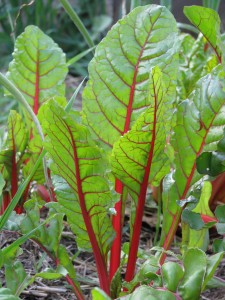
Swiss Chard Swiss chard is that bright green leafy vegetable, usually with a red mid vein, that most people inch past in the supermarkets. It looks so darn healthy it is scary, and also looks complicated and possibly bitter. I’ve been growing chard for years. One of the easiest of plants to grow from seed, this perennial in our San Diego climate reseeds itself if you let it. To harvest you cut off all the leaves except a few in the middle (to keep the plant producing food for itself). You can easily feed off of a few of these plants for years.
Chard is Mediterranean, not Swiss, but wherever its from it comes packed with antioxidants and many other great health benefits. There is the most common red veined chard that you see in the supermarket, and there is also white or yellow veined varieties. If you buy a package of seeds called Bright Lights, it contains seeds for a mixture of these. The taste difference is negligible, and since in preparing chard you usually strip the mid vein out, it really doesn’t make much difference except as color variety in the garden.
You can cut the leaves while very young and add them directly to lettuce mixes for salads, especially wilted salads. Or you can stir-fry them up or use them as you would baby spinach. The wonderful thing about chard is that you can use the old leaves as well. Older chard takes a little longer to prepare, but oh, it is worth the effort. To prepare older leaves, I fill half the kitchen sink with water, then with my fingers or a sharp knife, strip the green away from the mid veins and drop the greens into the water.
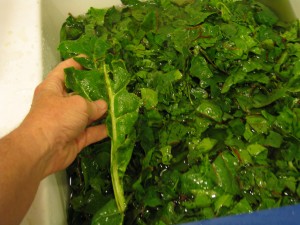
Strip the green part from the midrib Wash the greens well. If your garden doesn’t have a lot of mulch around the plants, then there might be soil kicked up on the leaves. Also, look out for any freeloaders such as snails or earwigs. I usually soak the leaves for a while, letting any thing extra float to the top or sink, then drain and rinse again. Squeeze the extra liquid from the greens and you are ready to cook.
If you want to freeze the chard for later, boil water in a big pot (depending on how much chard you have; you can do it in batches, too), then blanch the greens by briefly submerging them in the boiling water, fishing them out and bathing them in cold water to stop the cooking process. Dry the greens and freeze in containers.
This is my recipe for cooking chard, which my kids and I have loved for years. You can prepare it this way and eat directly, or use it as filling for enchiladas, frittatas, empanadas, or any other tas or das you may desire! Photos follow the print version of the recipe.
Chard SauteAuthor: Diane C. KennedyRecipe type: Side DishPrep time:Cook time:Total time:Serves: 4-6Swiss chard is easy to grow and a little more involved to prepare, but oh! how it is worth the effort!Ingredients- 2 tsp olive oil
- 1 large shallot (or half an onion, or a clove or two of garlic)
- ¼ cup vegetable broth or water
- 2 large bunches Swiss chard (or more)
Instructions- Wash, wring out, de-stem and chop large chard leaves.
- In a large saute pan (that is a frying pan with high sides), heat two tablespoons olive oil to medium high. Or, if doing a mondo-huge pile of chard, use a pot.
- Chop one large shallot, or half an onion, or a clove or two of garlic and add to pan.
- If using onion, then allow to cook for a few minutes until softened.
- Add wrung-out Swiss chard and stir a little.
- Add a quarter of a cup of vegetable broth (the greens will still hold water, so you don't need much broth. Or you can add the same amount of water).
- Cover the pan and reduce heat to low.
- Allow chard to steam for about twenty minutes (it should be simmering in there; if it isn't, turn up the heat a little).
- Lift the lid once and stir chard.
- At the end of the cooking time, remove the lid and turn up the heat.
- Allow any extra broth to cook until almost completely gone. Be careful not to scorch!
- Remove from heat, adjust the salt to taste, and serve. I eat it with butter, or sprinkled with Parmesan cheese is also good. Yum!!
Chard Saute
In a large saute pan (that is a frying pan with high sides), heat two tablespoons olive oil to medium high. Or, if doing a mondo-huge pile of chard, use a pot.
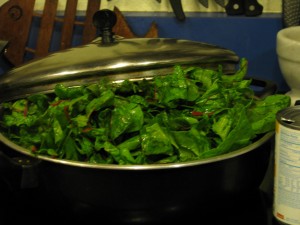
Pan o'chard Chop one large shallot, or half an onion, or a clove or two of garlic and add to pan.
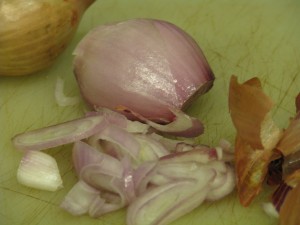
Slice shallots If using onion, then allow to cook for a few minutes until softened. Add wrung-out Swiss chard and stir a little. Add a quarter of a cup of vegetable broth (the greens will still hold water, so you don’t need much broth. Or you can add the same amount of water). Cover the pan and reduce heat to low. Allow chard to steam for about twenty minutes (it should be simmering in there; if it isn’t, turn up the heat a little). Lift the lid once and stir chard.
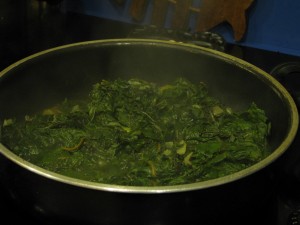
Stir the chard At the end of the cooking time, remove the lid and turn up the heat. Allow any extra broth to cook until almost completely gone. Remove from heat, adjust the salt to taste, and serve. I eat it with butter, or sprinkled with Parmesan cheese is also good. Yum!!
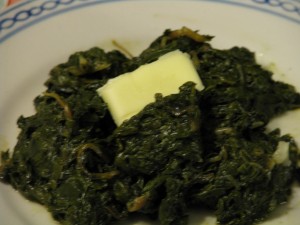
Buttered Chard: YUM! -
Idyllwild Photos

Boulder-studded hills This last weekend’s retreat to Idyllwild became extra special with the advent of April snow. I started out from Fallbrook at two o’clock, following my GPS through our granite-studded hills and golden-flowered valleys. As I drove through the Anza plateau in the beautiful afternoon sunshine, I started seeing glimpses of my destination, which the forecasters indicated would be snowy.
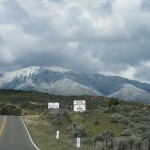
Snowy mountains Listening to my audiobook, occasionally holding up my camera to take photos through the windows (thank goodness for digital photos! All those random shots I can delete instead of pay to print and then throw out!) I reached the turn-off for Idyllwild and tall pines. I passed red gambrel barns, peaceful horse ranches, and then the first downy flakes started swirling around. I gave out a hoot to myself. Although I was born in New Jersey, my dear mother told my dear father that she never wanted to shovel snow again in her life, and they moved our family of five children West when I was five. I’ve visited snow a handful of times at Palomar when growing up, or with my children. Up until I drove through snow and ice in Ashland a couple of weekends ago on my trip to Oregon, I had little experience with it. Or did my Prius. On approaching town there was snow on the sides of the road, and it was swirling in large flakes.
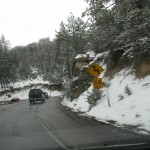
Snowy Road Traffic wisely crept along the icy road. Then suddenly, I was there.
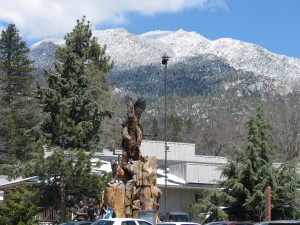
Totem (photo taken on the last day) I’d only been to Idyllwild once with my parents, some forty-some years ago. The only thing I remember was a large totem in the main square. I was startled to see it again as I arrived. It brought back good memories of my parents.
The snow had turned into round pellets, like those Styrafoam balls in Christmas scenes. I sat in my car outside the lodge for a few minutes absorbing the sight.
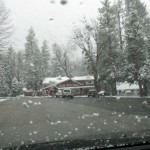
Round snow Oh, and it was cold. My spoiled San Diego self had to make some adjustments. Over the weekend I ended up wearing all the clothes I brought, mostly at the same time in various combinations starting with thermals. I thought I had mittens in my car but I didn’t, and I shouldn’t have had my haircut the day before, or thought to have brought a knit cap. But it was all okay. The lodge was comfortable, our hostesses treated us like royalty, I shared a room with a wonderful woman and we had a wall between us for privacy. The rooms were themed, and mine was, appropriately, The Library, and was decorated in old books and red plaid, which I love. It was perfect.
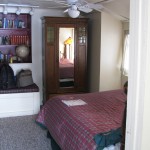
Plaid room After checking in and seeing my delightful room, I took my camera out onto the street and walked a circle around to town and back. I had to keep the camera nestled under my jacket to keep it from freezing. I wrapped my blue knit scarf that I bought when Miranda and I were freezing in the Orkney Islands when touring Pictish ruins around my head and neck like a babushka. I’m mature enough to sacrifice looks for warmth. ( At least, most of the time. I guess it depends on who is looking. Hmm, I’m still a girl at heart after all! ) The landscape was beautiful, like a picture postcard sprayed with glitter.
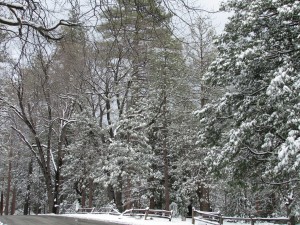
Snowy Trees The silence was so profound I could hear the snow fall. There was wildlife looking for food for their young. A mother Gray Squirrel was eating at a squirrel feeder. The bare spots on her tummy show that she is nursing young. I also saw Steller jays, robins, pine siskins, a flicker, crows, quail, goldfinches and acorn woodpeckers. There were bunny tracks in the snow.

Mother Squirrel That evening we communed by the fire in the lodge after a great meal of vegetarian vegetable soup and fresh bread. I enjoyed my cup of cocoa with peppermint Schnapps, but the caffeine made me sleep only three hours. I wasn’t alone with being tired; several other women had little or no sleep either. Saturday the sun was out and the snow began to melt, causing the streets to turn into running water.
Snow Flowers W e took a walk in the morning, ate macadamia nut pancakes, performed Tai-Chi, Zumba, aerobics, work at a barre, more walking, yoga and Pilates, then another walk into town for dinner. During dinner, it began to snow again, big, slushy wet snow that we hadn’t expected.
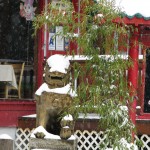
Hibernating Dragon It was dark when we finished eating, and we visited a couple of shops that stayed open for our group, then ventured through the very wet snowfall back to the lodge and warmth. It snowed all night again, to make our last morning one of magical landscapes. It was Sunday morning, the sky was blue with soft clouds, the quiet was profound and the snow sparkled as if someone had tossed around slivers of diamonds.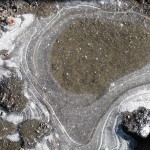
Ice A group of us took a silent walk through the snow and trees, not speaking, but pausing to perform simple yoga breathing and awakening stretches, welcoming the peace and freshness into ourselves and sending our thanks for the moment out to the universe.
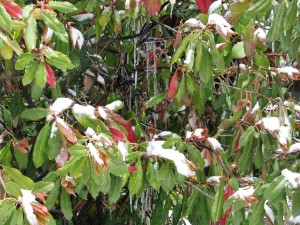
Icicles in Bush This exercise enervated me more than any other during the weekend; I only regret that not all of the women shared it with us. (After little sleep on the first night and a series of vigorous workouts through the day, along with all the energy spent shivering, several slept in.) One of the phenomenas of the morning was the rising sun catchingthe snow as it melted from the trees, highlighting the drops as if it were handfuls of glitter. I took many photos of it, trying to capture the spectacular sight, but none of them do it justice. If you look carefully at the photo, you can kind of see what I’m talking about.

Shimmering snowmelt After our wonderful breakfast (pecan maple pancakes!) we headed off down the mountain in glorious weather. I took a last explore through the town, finding a shop that made its own candles, some scented Idyllwild Cabin, and Campfire Smoke, and Citrus Champagne… and they really smelled like their names! I bought some Christmas gifts (beat the crowd! It was snowy outside after all!) and drove out of the snow to home.

- Easter Bunny Tracks
I’m posting more photos on my Facebook page if anyone is interested. The Spring Retreat turned out to be a Winter Wonderland, but I’m sure that it won’t throw the Easter Bunny off at all.