-
A Thousand Miles

Honk if you love geese! I intended to write yesterday, but the place where I stopped didn’t have Internet. Sorry! I left Fallbrook just before daybreak on Monday.

Five o'clock AM on Hwy 15 I saw beautiful clouds at dawn.

Dawn-kissed clouds I also saw a lot of car butts.

An hour inching behind car butts Ah, the roads to Los Angeles. I’m a seasoned car traveler now. I have my backpack next to me, one audiobook loaded with a couple of spares and some music CDs within easy reach, as are snacks, a water bottle, tissues, and my camera with the viewfinder turned out. I try to snap photos without taking my eyes off the road. Some photos turn out not so good.
Almost got it... Some turn out okay.

Mt. Shasta Stopping only twice for gas, I was on my eleventh hour driving when I encountered rain with low visibility and decided that enough was enough. I passed by many spots advertising places to stay; some I would have turned in for but was blocked by one of the ever-present trucks kicking up rain spray and edging precariously close to the middle line on the twisty, narrow stretch of I-5. I really wanted something with a nice view with a restaurant close by, but I was willing to stop for almost anything by that point. I saw a sign and pulled off and over I-5 through tall pines looming in the rain. Then suddenly I found myself looking at Shasta Lake and the Bridge Bay Lodge! I started to laugh! If I had planned the stop it couldn’t have been better!

Beautiful in the Rain They had a room… in fact, it was nearly empty, and a restaurant that wasn’t cheap but did offer vegetarian entrees. The rain set in, but I walked around a little before heading to bed. I made sure that I didn’t leave any food outside the door!
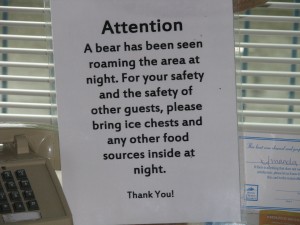
I'm not in San Diego anymore.... I watched a little television… I don’t have TV at home and haven’t watched it in about 16 years… and was shocked at how absolutely stupid and time-wasting the shows were. And I was switching between the History Channel, A&E, and National Geographic! I was horrified, and turned it off.
I awoke to a clear warm dawn, and what had looked like this the night before:
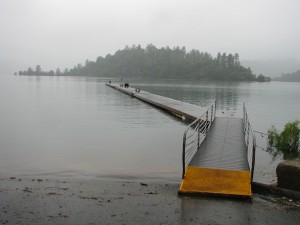
Dock in the rainy dusk now looked like this:
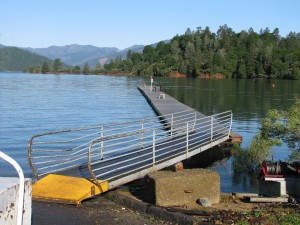
Dock in the morning And like this:
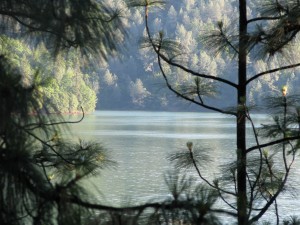
Dawn on Lake Shasta 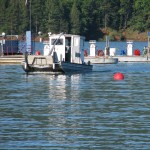
Out on the Lake 
Family outing 
Houseboats I was so thrilled. I’m sure the place is a zoo on the weekends, and I had a quiet night only because I had no neighbors, but it was food for the soul.

Flotilla of Canada Geese After having food for the tummy (breakfast is my favorite meal!)

- I love a silly name
off I went for the last four hundred miles to Corvallis, through absolutely gorgeous scenery. Tomorrow I give my hinder a break and don’t plan to do much driving, but help my daughter move out of her dorm in the evening after her last final and then head for home on Thursday.
I very much enjoy being out on my own. Although I planned the way back with my daughter with reservations for a bed and breakfast and tickets to a Shakespearean play in Ashland, OR the first night, and on a restored ferryboat hotel on the Sacramento river the second night, I like the spontenaity and roll of the dice of just driving unplanned. If I had no animals at home, I’d do what I had asked friends to do the summer after high school graduation (they all had summer jobs!) and drive the USA. I love the freedom. I love the thought that no one knows where I am. I love the fact that I could end up sleeping in the car or in a dive if my luck ran out, or in a wonderful place such as I just found myself at Shasta Lake. As long as I can share it with all of you!

Sparkling Water -
Until Next Week….
I’m about to do the drive from Fallbrook, CA (in San Diego County) to Corvallis, OR again. Almost exactly a thousand miles. I’ll be back home in six days (I’ll be blogging as I go, though!). However, the day before a trip I get a little crazy. I whip myself into a cleaning and organizing fury. Part of it is that I like to come back to a clean house. Part of it is that I have a lot of animals and I want to make sure that they are all as set up as possible with food, water and clean bedding, even though they’ll be taken care of on a daily basis while I’m gone. Part of it is that I get a kick out of multi-tasking and coordinating, and I burn off a lot of pre-travel worry this way. I shop and stock up on animal food, I do laundry, hauling wet sheets and rugs out to the clothes line and back in again. I cook, take out recyclables and trash, pack and blog. I soak and scrub cat and dog dishes, I sweep the walkway (why? I don’t know. It will be gunky by the time I get back), I clean out the last of the honey that is dripping from crushed comb and give the bucket to the bees to clean up. (Straw on the bottom keeps the bees from becoming stuck in the honey and drowning.)

Bees cleaning up honey I water everything. I wash the dogs and their bedding. I leave unnecessary notes.
It is wise to keep out of my way on the day before a trip.
Work will go on in the yard while I’m away. I’ll tune in next week to find out the answers for….
Will the lower pond be filled, and not look like green tea?
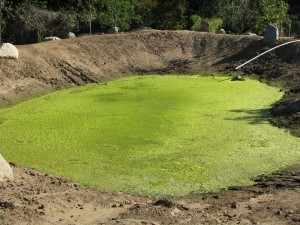
Pond algae Will these palm trunks become a bridge?
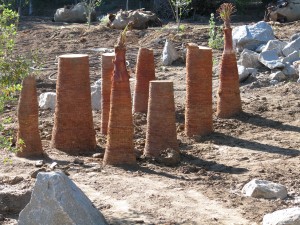
Bridge pilons Will these fancy new stairs made from cement chunks lead to something?

New Steps Will the jasmine hedge still be blooming?
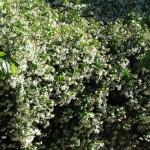
Jasmine Hedge Will the giant sunflower ever look up? Will the vining vegetables take over the property?
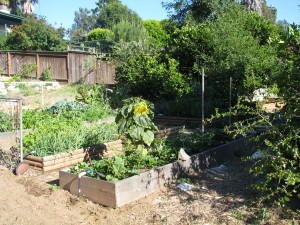
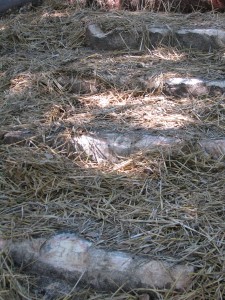
Garden Growing Will whatever is eating the stairs leave any to walk on?
Chewed Steps Will the subterranean irrigation lines be buried?

Irrigation lines Will the kumquats ever get cuter? (Impossible. Too fun a name, to say and to spell. Go ahead, say it: “Kumquat, kumquat, kumquat.” See? Cute name for cute fruit.)

Kumquats These and other questions will (in all probability) be answered next week. Stay tuned for the answers… same bat time, same bat station.
You May Also Like
Native Insects and IPM
-
Natural Cleaning Products: Vinegar

Vinegar Cleans Glass Beautifully I’m on a personal crusade to remove all non-environmentally friendly cleaning products from my home…. life… universe… well, I’ll start at home anyway. Not only does my house utilize a septic tank and I’m not supposed to have scrubbing bubbles living a dark life beneath my yard, but harsh chemicals are bad to breathe, bad to have eat through the skin on my fingers, and bad for the environment and water. So how on earth did humans clean prior to the chemical revolution? With what they had around them, of course. They usually had wine, or some sort of fermenting juice around, and after the fermentation was gone they had vinegar. Anything that smelled that strongly had to clean well, and it actually did and does. Undistilled vinegar, or acetic acid, has antiseptic and antibacterial properties that were written about by Hippocrates, the father of medicine.
There has been a foodie revolution with artisanal vinegars, and now people who rarely cook anything but a TV dinner know what Balsamic or wine vinegar is. If you’ve ever been to England you’ll know about shaking malt vinegar onto chips (French fries), which is absolutely delicious, by the way. But the vinegars found in grandma’s pantry were cider vinegar and white vinegar.
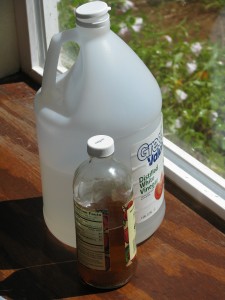
White and Cider Vinegar Cider vinegar has an old-fashioned flavor and is used in cooking, especially Eastern European foods. There was a huge health fad when I was little about the benefits of drinking apple cider vinegar, and people still swear by it. My mom gave us a glass of warm water with cider vinegar and honey in it to drink with our dinner. I got to really like the taste. Undistilled cider vinegar has a floating mass in the bottle; that is called the ‘mother’, and it is part of the fermentation process, and can be removed and used to help ferment other vinegars. People don’t like that mass, so they invented white vinegar which has little of the nutrition that cider vinegar has.
White vinegar is made from fermented grains, mostly corn, and this is the product that is now used in cleaning because it won’t leave a brown mark and is less expensive than other vinegars. There are hundreds of uses for vinegar, besides setting color when dying eggs. What vinegar is really valuable for here in Southern California with its mineral-heavy water, is to clean out those mineral deposits from machines and glassware. Glass vases that had acquired rings inside from holding tap water, which didn’t come out with a brush and soap, became clear and beautiful when I filled them with vinegar and water and let them soak for an hour. The same for a crystal decoration that is filled with water and hung to catch the light, filling the room with prisms.

Crystal Clear It had mineral buildup and was ugly (now I use distilled water in it!), and after a vinegar and water soaking, and a little nudging with a long, skinny brush, it is beautiful again.
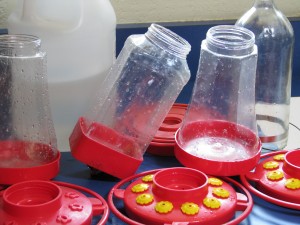
Cleaning Bacteria from Hummingbird Feeders Hummingbird feeders must be cleaned regularly because the black mold that grows on the feeder holes will infect the hummingbirds and eventually kill them. I’ve always used a bleach solution to soak them. No more! I use hot water and vinegar to soak, then use straight vinegar and a brush to kill any germs around the bases. I’ve noticed that besides not being gassed with the chlorine bleach fumes, that the feeders stay clean just as long as they had when I used bleach to kill the germs.
I was talking with a friend about dishwashers and how glasses weren’t getting clean and the dishwasher just wasn’t performing well anymore. She passed on the tip from another friend to dump a whole gallon of white vinegar into the machine and let it run. The vinegar loosens up all that mineral yuck that clogs up the works. It works in drains, too.
Vinegar cuts through grease and grime, like that scary fuzzy layer on the top of your refrigerator, or that grease build-up over the kitchen range. I switched to cleaning windows with vinegar water and newspaper, and have had great success.
Combined with the alkaline baking soda (bicarbonate of soda), vinegar fizzes and was what made your fifth-grade Science Fair volcano erupt, or the toy submarine skim through the pool (I loved mine!). Mixed with some dish soap, these three ingredients work well to remove stains, such as those in the shower or on counters. Use the paste on an old toothbrush to clean up grout.
Other uses for vinegar include as a hair rinse, to make hair supple and shiny; in water when boiling eggs so they won’t crack and they’ll peel more easily (give them a cold water bath right after cooking, and try not to use very fresh eggs, which are very hard to peel after boiling). Run it through the coffee maker, or in the bottom of a kettle to dislodge the chunks of minerals that stick to the insides. Go on the Internet and search for lots of ideas on how to use vinegar in your routine. Vinegar is safe, efficient, natural, and its smell isn’t any worse than that of chemicl cleaners, and a lot easier on your lungs.
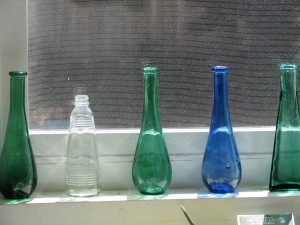
It dissolves hard water stains -
What is a Weed, Anyway?
Weeds are plants that grow where you don’t want them to. It is a label given with purely human whim that often interferes with nature taking care of its animals and soil. Unless you are removing invasive species, weeds have a purpose and can not only be useful medicinally, but also are indicator plants of how healthy your soil is.
In the February 1989 issue of Organic Gardening, I wrote an article called Selective Weeding. In it I described how weeds with deep tap roots not only break up the soil, but are nutrient ‘miners’; they take up minerals from down deep in the earth, send them up to their leaves, and then leave them on the soil surface when the leaves die, which improves the quality of the topsoil for other plants to thrive. Around here, wild radish is the most notable weed that does this although it is invasive, but it isn’t the only one.
Other weeds make good groundcover, such as purslane. Purslane needs fertile soil to thrive, so when you see it, you know there is good soil. It is also edible and a good source of calcium, iron and Omega-3 fatty acids…. a real plus for we vegetarians who don’t eat fish. Lamb’s quarters also grows in highly fertile ground and is very edible. Red clover also loves fertile soil and it’s importance to the pollinator insects is vital. Clover roots set nitrogen in the soil and is often used as a cover crop.
Plantain (Plantago major and not the banana) is naturalized throughout North America and I guarantee that everyone has seen it whether they know it or not. The variety with rounded leaves in a rosette is a common lawn weed, and the variety with long, lanceolet leaves with long veins that grows by waterways is much larger. Why streams and lawns? It thrives in soil that has low fertility and high ratio of water. Plantain makes an excellent salve for stinging nettle rash, insect stings and some say poison oak rash. If you brush against nettle while hiking you’ll know right away because it releases chemicals into your skin that burns for awhile and then dissipates. Look around for plantain, break a leaf and roll it between your fingers till it releases the juice and apply to the site.
Nettle is another great plant even though it stings in self-defense. The chemicals that sting are water-soluable, so if you pick young nettle and soak it or cook it like spinach, you have a green that is very high in Vitamin K, protein, calcium, maganese and potassium. Nettle soup is commonly served in other countries. Nettle is an indicator plant of soil that is high in nitrogen and phosphate, which explains why it often grows around abandoned buildings and farms where there has been animal and human waste. Nettle is the host plant for many butterfly species as well.
Poison oak has a place in our native forests as well. It is a plant which happens to give off a chemical that humans find irritating. It produces berries that birds rely on, it provides shade in the understory to hold in moisture and give safe harbor to many animals, it is beautiful with its bright green spring growth and dark red autumn shades. The entire plant produces an oil that gives most people a rash, which doesn’t begin to irritate the skin for several days. Thinking about the substance being an oil will help you consider how to deal with it. If you or your dog brush it, the oil will transfer to your clothes, skin or your dog’s fur (another great reason why you shouldn’t let your dog run off-leash in natural areas!), and transfer again when it is touched. If burned, the toxicity is increased and you can inhale the fumes and become critically ill. If you think that you’ve brushed against poison oak, wash your clothes separately from the rest of the laundry and wash your skin well. There are many products on the market which help dissolve the oil, such as Technu, which is a wash for just after you’ve touched the plant. On hot days the plant’s oils carry in the air so people who are very sensitive should avoid poison oak habitat in the summer.
Weeds that indicate compacted soil, which is low in oxygen, are bindweed (looks like a small white or pink morning glory), quackgrass and chicory with its tall blue flower. Chicory’s deep taproot mines the minerals and breaks up the soil, and bindweed covers the soil providing some shade and protection against more compaction and dropping leaves over an extended area for mulch. Quackgrass secretes a chemical that supresses other plant growth as it travels via rhizome, breaking up the soil surface and carpeting it for protection.
Dandelions, a weed of childhood fantasy, of back-country wine, of spring tonic greens, are happy little plants that lawn owners ruthlessly kill. They grow in many soils, but are indicators of acidic soil. Henbane is a sign of alkaline soil.
Whether you keep your weeds, selectively weed, or eradicate them all, you should at least learn what they have to tell you. A good list of California weeds is at http://www.ipm.ucdavis.edu/PMG/weeds_intro.html .. An extremely valuable book that I have used so often when conducting hikes (and there is always a little girl that asks what every little plant is along the way), is Roadside Plants of Southern California by Thomas Belzer. It has photographs, descriptions and whether the plant is native or not. Another book is the Natural History of Vacant Lots by Matthew Vessel et al. These are wonderful guides for all the plants that fall between the cracks of most plant ID guides.
Just remember that plants communicate to you, and each have a purpose to fulfill. Whether it be as a mineral miner, a canopy or shade plant, a pollinator and food source, a nitrogen-fixer, a soil breaker, a mulch plant, each is doing something to help build earth fertility. Plants that are non-native take the place of the ones that are native and important to an area and its habitat, supplanting perhaps a plant that is the host for a particular butterfly. Be enlightened when doing yardwork. Feel free, though, to eradicate any Bermuda grass that you see, because it is a weed against which I have a personal vendetta! Happy gardening.
- Gardening adventures, Permaculture and Edible Forest Gardening Adventures, Photos, Vegetables, Vegetarian
“Who’s That Chewing on MY Step?” or, Garden Update June 1

Hidden Treasure Many of the steps that were created out of the Washingtonia palm trees are doing just fine. However, there are some that were squared off with a chainsaw and their whiteness and neatness really stood out on the hillside. They stood out a little too well, apparently, because something is gnawing away at them!

Chew Marks It can be either rats or bunnies, and I’ve only found bunny scat in the straw. In defense of my nice stairs, I’ve sprayed them with Bitter Apple, which is a product used to spray on doctored pets to keep them from licking or chewing on bandages.

Heart of Palm I spread the straw over the steps again. I’ll see tomorrow what has happened.

Cherries! Other finds around the garden are my first (and probably only) two cherries! Cherries are not known to grow in our Zone 10 climate; however, there are a few hybrids that are supposed to be ‘low chill’. Cherries are one of my favorite fruits, so I’m thrilled that this tree is giving it a go.

Magnolia The magnolia trees are blooming, and a transplanted Blue Girl rose is much happier in the Blue Garden, which is also the Bee Garden.
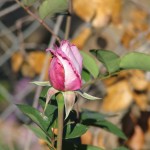
Blue Girl A vegetable garden is a stern taskmaster. After all that waiting at the beginning of the year, plants are flourishing. This is the best garden I’ve ever had. After all that work building raised beds, lining them with aviary wire and filling them with good soil, it had better be good!

Last Two Beds I have two more raised beds to level, line and fill. I have more pumpkin seedlings up and I need the beds ready to plant. I can’t believe it is June first already.
Today I put up strings for the pickling cucumbers and the pinto beans to climb on. Those two beds, which are the newest and which have the least amended soil, are still doing very well.
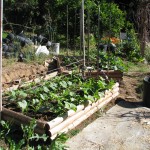
Strung Up I also staked the three yellow tomato plants, and three ‘soup bean’ plants, as well as planting more of those beans by more stakes.
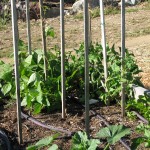
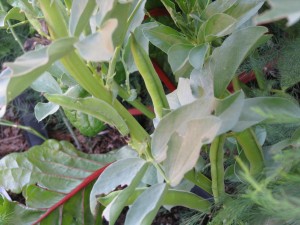
Bean and Tomato Stakes I had no idea that fava beans grew up! I mean, the beans don’t dangle like other beans do, but grow straight up, like huge fat caterpillars. Crazy! I also read where the young leaves are tasty so I tried one… then I ate several. They are much more flavorful than pea shoots.
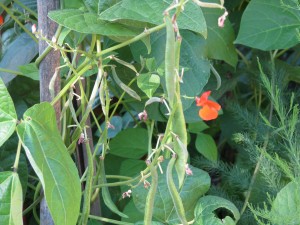
Fava Beans Scarlet runner beans grow down, but are slightly fuzzy, which is a little creepy. They can be eaten young, or let dry on the vine.
Runner Beans are Fuzzy I planted a white and yellow sweet corn, now that the popcorn is well up. I’ll wait a month to plant the full yellow sweet corn, not only to stagger harvests but because corn will cross-pollinate. Meanwhile, I have my trusted rubber snake watching the bed.

Corn snake This package contains carrots of various colors, so I planted some just for fun. I’ve heard that some of the darker colored carrots aren’t that sweet, but I want proof.
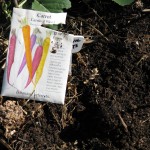
Crazy Carrots When spacing seeds for corn or other plants which need room, use your trowel as a guide. It is about a foot long, and corn needs to be a foot by two feet apart. Plant corn in blocks so that they can pollinate better; the pollen will drift off the tassels onto the silk of the neighboring corn.
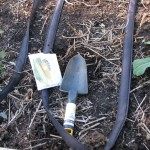
Trowel Ruler I also planted cinnamon basil, which has the most wonderful aroma. You can use it in cooking, especially for sweets, but I just let it go to bloom, then cut some and set them in water in the house for the perfume.

Cinnamon Basil This bed contains garlic, shallots, bush beans, tomatoes and basil, all of which are contending for sunlight. The bed receives sun all day and the rows are planted south to north, so the plants won’t shade each other for any length of time.

Full Bed The sunflower that was pouting last week has trouble staying awake this week. Her heavy head just can’t be lifted. Lesser goldfinches love to eat the leaves, leaving them skeletonized.
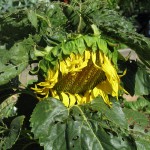
Heavy Head Of course, the best thing that is growing in my garden is this volunteer melon, which appeared under the peas I just cut out, and now that it has found the light, so to speak, it has grown one and a half feet long and going strong, and has a flower! But what is it? A remnant from melons I planted in the past? Seeds from the compost from melons I have eaten? There’s nothing like a mystery!
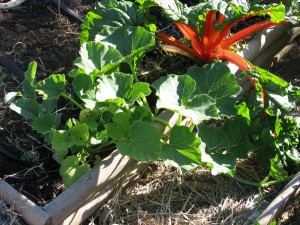
Volunteer Melon -
Popovers (and a Pumpkin Turkey Cake Story)
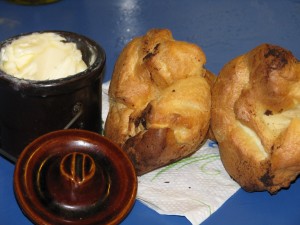
Serve Popovers Hot Popovers are usually thought of as a type of roll to make with roast beef, using the suet as the shortening and using the popovers to sop up the beef ‘juices’. In the immortal words of Penfold of the Danger Mouse cartoons, “Oh, ick!” I’ve made vegetarian popovers for many years and they are not only extremely easy to make, but fun to eat. My recipe contains dairy products, but any vegan cook could whip some up with rice or soy milk.
Popovers are made from a simple batter which relies on very high heat and steam to make them puff. There are two baking temperatures, the first is high to create steam for the lift-off, so to speak, and the second is moderate for the cooking through to the tender insides. For the last few minutes of baking you should stick each popover with a fork to release the steam, otherwise they’ll end up soggy.
You have to eat popovers right away, with as much butter as your conscience will allow. Or use them to sop up vegetarian gravy. You can also add cinnamon or nutmeg into the batter and serve them for breakfast.
For years I made popovers in oven-proof custard dishes. They didn’t rise as high and were wider than normal, but me and my children managed to choke them down pretty well.

Oven-proof custard cup Then I bought myself a real popover pan. I’m a real sucker for shaped baking pans. I think I could keep Nordicware in business if I didn’t control myself.
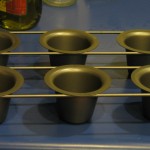
Popover Pan I don’t even bake very much anymore, but I do love my castle bundt pan, or turkey cake pan that my daughter bought me (there is a story there. I’ll tell it later*.) There are worse vices. I think. The popovers in the popover pan look terrific and are very impressive, but they eat just the same way that the custard cup ones did. So, go make some popovers! What are you waiting for?
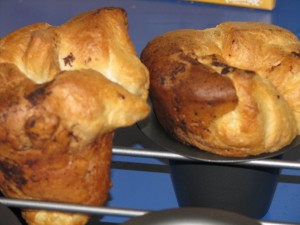
All popped and waiting for butter! PopoversAuthor: Diane KennedyRecipe type: BreadPrep time:Cook time:Total time:Serves: 6Popovers without the suet, for lacto-ovo vegetarians and the world!Ingredients- 1 tablespoon butter or vegetable oil
- 2 eggs
- 1 cup milk
- 1 tablespoon vegetable oil
- 1 cup all-purpose flour
- ¼ teaspoon freshly ground pepper (opt.)
- ½ teaspoon ground cinnamon or nutmeg if you are making breakfast popovers)
Instructions- Heat oven to 400 degrees F.
- Put ½ teaspoon of butter or oil in each of six 6-ounce oven-proof custard cups or in each cup of a popover pan. Coat the bottom and sides.
- Place custard cups on a cookie sheet, if using.
- In a blender, mixer, or in a bowl with a wire whisk, beat eggs, milk and oil until combined. Beat to blend; don't incorporate too much air into the batter.
- Add flour (and spice if using) and combine until smooth.
- Divide batter between prepared cups; each should be half full.
- Bake for twenty minutes in 400 degree oven, then reduce the heat to 350 and bake fifteen minutes more.
- Turn oven off.
- With the tip of a knife or a fork, prick the tops of the popovers and allow them to stay in the oven for about five minutes more. Popovers should be firm and crisp on the outside, and tender on the inside.
- Remove popovers from oven; turn out of pan or cups and serve immediately.
- Makes six.
* Okay, so here’s the turkey cake story. My daughter gave me this fabulous turkey cake mold last year. I decided to have Thanksgiving early with my son, then fly to her university to have Thanksgiving with her. I made most of the meal and packed it up in my carry-on (no liquids!). After some debate with myself, I caved in to my sillier side and baked a pumpkin cake in the turkey pan and sandwiched the sides together with buttercream frosting. It looked perfect! I wrapped that sucker up in lots of plastic wrap, stuck in on top in my carry-on, and headed for Carlsbad airport.Flying out of a small airport is the only way to go. Small lines, easy parking, and a not-so-hostile security. When my carry-on went through the X-ray machine, I wasn’t surprised when they pulled it off and called me over. I explained to the very nice female officer that the dark blob in my bag was a pumpkin cake shaped like a turkey. She said that they’d have to check it again, which they did. She and another security officer had a good laugh at the image and when she brought it back to me she said that in profile it looked exactly like a small real turkey on the screen. Then much more seriously she asked if I was going to change planes on my trip. When I told her that I was, in Los Angeles, she quickly advised, “Don’t go out of the security area there!” I don’t think the Los Angeles airport security force, on a high-risk day-before Thanksgiving holiday, would feel so friendly towards my turkey cake.
-
Well, Well, Well!

A Big Rig The battle for the water looks as if it is slowly being won. Today a 100 foot deep eight inch hole was drilled behind my pond. I feel sorry for the earth, like a big mosquito has stabbed into it’s bedrock.Fain drillers had quite a time maneurvering their truck in backwards. A portion of the fence had to be removed for the ginormous truck to back in. Then it had to move back and forth by inches to get around all the plants and rocks.
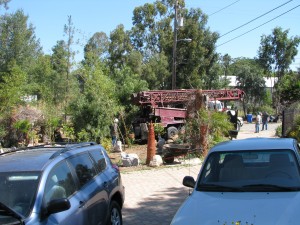
Backing through the fence 
Backing down the property Finally it was in place, and they balanced the truck with lifts so that the back end was off the ground!

Leveling the truck Raising the drill bit was very impressive. It is so tall!

So tall! As they drilled, up came slurry of water, clay, and decomposed granite.

Water and slurry They drilled 100 feet today, and and found water that is moving at about fifteen gallons per minute.

Adding bits For the drip system, I only need a mere five. However, I don’t know what may happen, if I may want to hook the house water up to the well some year or something. If I have them drill more deeply now since thieir truck is in the yard, the well might have a better rate of flow, better water, and possibly a more reliable supply.

Changing parts What I have might be just fine, and there is no guarantee that anything will improve with more drilling. I’ll make my descision over the weekend. On Tuesday they’ll drill some more if I want it, then put in a casing, gravel around the casing, cement the top, and then we can lower the pump and get well water! Cross my fingers!
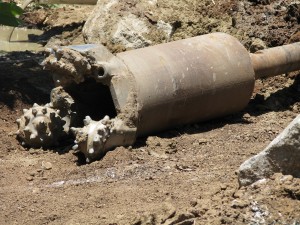
Mean-looking grinding bit -
Drip

Lines layed out up the property The key to any garden is the availability of water. Today I signed a contract to have a well drilled on my property to furnish irrigation and pond water. The irrigation for the permaculture project, and for most of my other gardens, will be subterranean drip. Yep, this is expensive. However, it will pay off in long-term water bills, plant loss due to drought or the heavy salt that is found in our water (the well should pull from beneath the salt penetration), and the replacement of sprinkler heads, broken PVC pipe and connectors for which my dogs and tortoise seem to aim.

Drip lines uncoiling As the plant guilds mature and roots and loam deepen, the less water I’ll need to provide for the gardens. The system will be there for the drought months, and for future unknown circumstances.

Where future plants will be I have the luxury of having a little inheiritance to spend on having others install this garden for me. That is because I do not have the luxury of having available labor in the form of willing, available and capable family members, nor do I have the physical strength in my back or hands that I once had to do it all myself. And I want it done NOW, so that I can play with it, enjoy it, plant and replant it, watch the habitat fill with animals, and show others what a success permaculture can be so they can practice it themselves.

Irrigating the beans and vines My real thrill is in my veggie garden. As I’ve mentioned before, I’ve had a garden most of the twelve years I’ve lived here, and have been foiled by bermuda grass and gophers. I finally was able to nail together boards from an old bookshelf to make raised beds, then buy on sale some pre-made raised beds. I’ve stapled aviary wire into the bottom, leveled them, filled them with a mixture of dirt, compost and whatever else that could fill those babies up. I’ve used natural fertilizers and microbes this year to energize the soil, and ran PVC pipe to each bed with a riser and a split hose bib on each one.

Double hose bibs Finally today I finished the drip system in each bed. (Yey! Hurray! Whoopee!). I’ve used drip irrigation before in the beds, with the long black soaker hoses perforated all over so that they ooze water. They say that they can be buried, but the mud cakes onto the tubing and gums it up. Also, to connect pieces you have to ram ends onto the cut ends which I have found really hard to do. Then you have one configuration of the hose with not many options for change. Ick!

Old soaker hoses I found another kind of drip hose (at WalMart) which is 75 feet of thin plastic tubing sheathed in a permiable nylon casing.

Plastic tube inside a nylon sheath The hose is fitted with a male and a female hose end, and the whole thing rolls up. Perfect!

Flexible drip hose! What I wanted was to be able to lay out drip from each hose bib on each bed that could be rolled up without a fuss when I’m working on the bed. I also wanted individual controls in the beds so that I’m not watering a bed that isn’t planted, or I can water half a bed and not the other half, or allow more water for crops such as melons and little water to crops such as quinoa… all at the same time! Complete control! Ease of use! Water savings! Ha!
Instead of using both sides of the divided hose bib for each bed, at this time, I ran one line in each bed. I can and probably will change that later which won’t be a problem, but I wanted to get these babies going! Since my beds don’t need 75 feet of hose, I lay down the amount needed then cut the end, tying a knot in it to stop the flow of water.

Tying off the end On the next section of hose I attached a female hose end, and moved onto the next bed.

Attaching female hose ends It worked! I had to adjust two of the hose bibs that leaked, but with my trusty Phillips screwdriver all went well. I have two more raised bed frames that I bought to install, and I have hose enough for both of them left over. I still have a sprained wrist (I’m really trying not to use it much, and wear a brace, but there is just so much to do!) so digging and leveling the ground for the beds is probably not a good thing for me to do right now, and I sure have a lot of weeding to do in the front yard (left handedly!), so the beds might wait.

Quinoa doesn't want much water So I’ve conquered the gophers, and I’ve conquered the hand-watering and bad drip hose, but I am seeing bits of that darn Bermuda grass coming up in some of the beds. I swear that that stuff could come up through anything. I’ve seen it break apart asphalt, and also come out the top of a six-foot pipe. Horrible, nasty stuff. Fortunately the soil is so much better in my beds now, it is easier to root around and pull the stuff out from way down low.
Anyway, that’s my drippy story for the day. I’m immensely happy about my veggie garden, and slightly less panicky about the dry days cooking all the new plants in the permaculture garden if I’m not out there dragging hoses around with my bum wrist watering for several days. And I didn’t talk about peas once. Oops!
-
Plantain Chips, or Tostones

Bananas versus Plantains A couple of years ago my daughter and I enjoyed a five-day birding tour of the high country in Ecuador, then an eight-day tour of the Galapagos islands. Being vegetarian wasn’t a challenge there; we ate very well and enjoyed foods that we hadn’t encountered before. One of the foods that was in many meals was plantain. Plantain around here means the lawn and stream-side weed that helps treat stinging nettle and insect bites. However plantain the fruit look like bananas, but are prepared very differently. High in iron, potassium and fiber, they are very versitile and often used in recipes instead of potatoes.
Plantains can be used in three stages of ripeness. When they are green they are starchy and hard to the touch. They are often boiled and mashed like potatoes. When they are yellow, they are sweeter as the starch has converted to sugar, but still not soft and are difficult to peel. When they are black, but not mushy, they are sweetest.
A common snack in South America and also in Africa are plantain chips. In Ecuador they are called tostones and sold in bags like potato chips. They are very easy to make, and very yummy to eat. Photos follow the recipe.
Plantain Chips, or TostonesAuthor: Diane KennedyRecipe type: SnackPrep time:Cook time:Total time:Serves: 2-3Fruit snack chip found in South America and Africa.Ingredients- Three plantains, yellow or slightly black
- Oil for frying
- Salt.
Instructions- Boil a small pot of water and submerge the whole unpeeled plantains for several minutes. The skins may begin to crack.
- Remove from boiling water and allow to cool.
- Peel the plantains and slice into ¾ inch disks.
- Heat enough oil on medium-high heat in a large skillet to cover the bottom.
- Lay sliced plantains in the oil and fry for about three minutes. They will be soft. Remove from oil and place on a plate lined with paper towels.
- Keep the oil temperature the same.
- Using the bottom of a glass, flatten the softened plantains so that they are very thin. Sliding a metal spatula under each chip when smashing helps. (A Puerto Rican version has you dip the disks into cold water just before refrying, to make them crisper. It would also make the oil splashier.)
- Lay the flattened disks back into the oil and fry for another three minutes or so.
- Remove the now crisp disks to a paper towel for draining.
- They will crisp even more as they cool slightly.
- Eat as is, or lightly salt, or sprinkle with chili-lime powder.
- They are very good with dip, too.
- Makes about thirty chips.

Scald whole plantains to make peeling easy 
Peel cooled plantains 
Using a spatula under the plantain slice helps when squashing with a glass 
Fry slices a second time .

Nom! -
Taking the “Ew!” out of Tofu

Working Tofu Magic I’ve been an ethical vegetarian for seventeen years, raising both my children without animal protein as well. Believe you me, packaged vegetarian foods have come a looonng way in palatability. There is a whole new world of packaging rife with misspellings and quotation marks, such as “chickn” and “bakon”, just to make sure that no hen or pig will sue the company for false representation. Many vegetarian options were simply god-awful to eat; some still are. It is still hard to find products that aren’t filled with pieces of red and green peppers (ick!), whose flavor permeate the rest of the food making it disgusting if it had been palatable at all in the beginning.
There are wonderful meat substitutes that can vary a menu and add protein, and the ability to create mock meat has become an art and can be found in many restaurants, especially Thai or Chinese. I order several times a year from May Wah in New York, who sells mock meats created in Taiwan. Morningstar Farms makes wonderful standards such as fake bacon, sausage links and patties, chicken strips and meatless crumbles (like ground beef).

A host of good pseudo-meat products When my daughter and I toured England four years ago, the popular vegetarian option on all the menus that year was mushroom risotto. We ate quite a lot of mushroom risotto, as well as some very strange stuffed onions which were stuffed… with more onions.
Although there are many interesting varieties of fake meats, the least expensive and easiest way to provide extra protein to your diet (other than beans, kale and dairy products, etc.) is to learn how to prepare tofu.
Tofu is prepared soybean curd. It comes either in a water bath tub which must be refrigerated or in asceptic pouches which can be stored at room temperature. On the label you’ll see that it comes in ‘soft’, ‘firm’ and ‘extra firm’ for different uses. Most beginners at eating tofu say that it has no flavor and it just soaks up the gravy and seasonings it is cooked with. Not so. Fresh tofu has a delicate, fresh flavor that is available to a palate that is not overly spoiled by too much salt and seasonings.

Types of tofu I’ve grown to like the soft tofu as much as the firm, cooking it so that the outside has a crisp texture and the inside is smooth, and that is the recipe I’ll give to you shortly. For those who want something chewier, there is a great trick to make tofu more meat-like. Freeze it! This works best with firm or extra-firm tofu that is in a water bath tub. Freeze it, then thaw it out, press out the water, slice it however you want and throw it into whatever you are making. It is much more like a sponge and has more texture.
For fresh or thawed tofu, you should drain it. Pressing it is easy and can be done while you are gathering the rest of the ingredients for your meal. Just put a plate on top of a cake of tofu, which is on a cutting board or plate by a sink, and set a heavy can or two on top.

Nice hat You’ll be amazed at how much water runs off. If you happen to own a Japanese pickle press (you don’t? Oh, you should!) it is really easy to press tofu.

Say 'Pickle Press' ten times fast. Go! I bought mine at Green Apple Japanese Market in Oceanside for about five dollars. The screw press holds the vegetables down into the brine, or acts as a torture device for tofu. If you press thawed tofu, it’s texture becomes so spongy that it doesn’t easily fall apart and you can squish it down pretty far! It’s fun!
A simple way to prepare tofu is to press it for no less than five minutes, slice it, and pan fry it.

Sliced tofu I use a combination of olive oil (because it is one of the most recommended foods that you can eat, and you should have about two tablespoons a day!), sesame oil for flavor, and a product called Bragg’s Amino Acids. It is similar to soy sauce or tahini sauce, but is far less salty and very healthy, providing extra amino acids to your diet. I buy it at health food stores such as Henry’s Marketplace.

Tofu and his cooking buddies If you aren’t going to go run out and buy some right now (whyever not? Pick up a pickle press while you’re out!) use a little tahini sauce, or very lite soy sauce. As these sauces cook, the salt condenses and overpowers the flavor of the foods. So, to one cake of sliced tofu, I put about two tablespoons olive oil, half a tablespoon sesame oil and one tablespoon Bragg’s Amino Acids in a frying pan and heat it to medium-high. I mix them together to cover the bottom of the pan and set in the tofu slices. The more moisture in the tofu, the more it will splatter, so I turn up the heat a little more after setting the slices in the pan. I also use a splatter guard.

Cook slices in pan with splatter screen The slices should sizzle. Cook for about ten minutes, then turn them for another five. They should be light brown. Add them to vegetables, serve them seperately or top a bowl of noodle soup with them. A varient on this recipe is to use extra-firm tofu, well drained, sliced into smaller pieces and cooked at a higher temperature for a little longer. The pieces become crispy… mmmmm!
You can add soft tofu into smoothies or puddings, or scramble them to make something that really doesn’t taste at all like eggs but can be very tasty as well as nutritious with the right seasonings.
So don’t be afraid of your tofu. Buy it as fresh as you can (there is a tofu maker in San Diego!) and play around with it. Look for tofu that specifies non-GMO soybeans. There are so many ways to prepare it, but this method is quick and simple for busy people, and very tasty, too!